What Are Salary Arrears?
Salary arrears are the additional salary payments made to an employee for a previous pay period due to delayed salary revisions, promotions, corrections, or missed payments.
Instead of being paid in the original payroll cycle, the pending amount is paid in a later payroll run as salary arrears.
Common Reasons for Salary Arrears
Salary arrears may arise due to:
- Salary revisions with retrospective effect
- Promotions effective from an earlier date
- Delayed payroll processing
- Missed overtime payments
- Attendance or leave corrections
- Bonus or incentive adjustments
- Payroll calculation errors
Salary Arrears vs Bonus
Although both increase an employee’s earnings, they serve different purposes.
| Salary Arrears | Bonus |
| Payment for previously unpaid salary | Additional reward paid by the employer |
| Based on salary revisions or corrections | Based on performance, festivals, or company policy |
| Forms part of regular salary | Usually a separate payment |
How to Calculate Salary Arrears
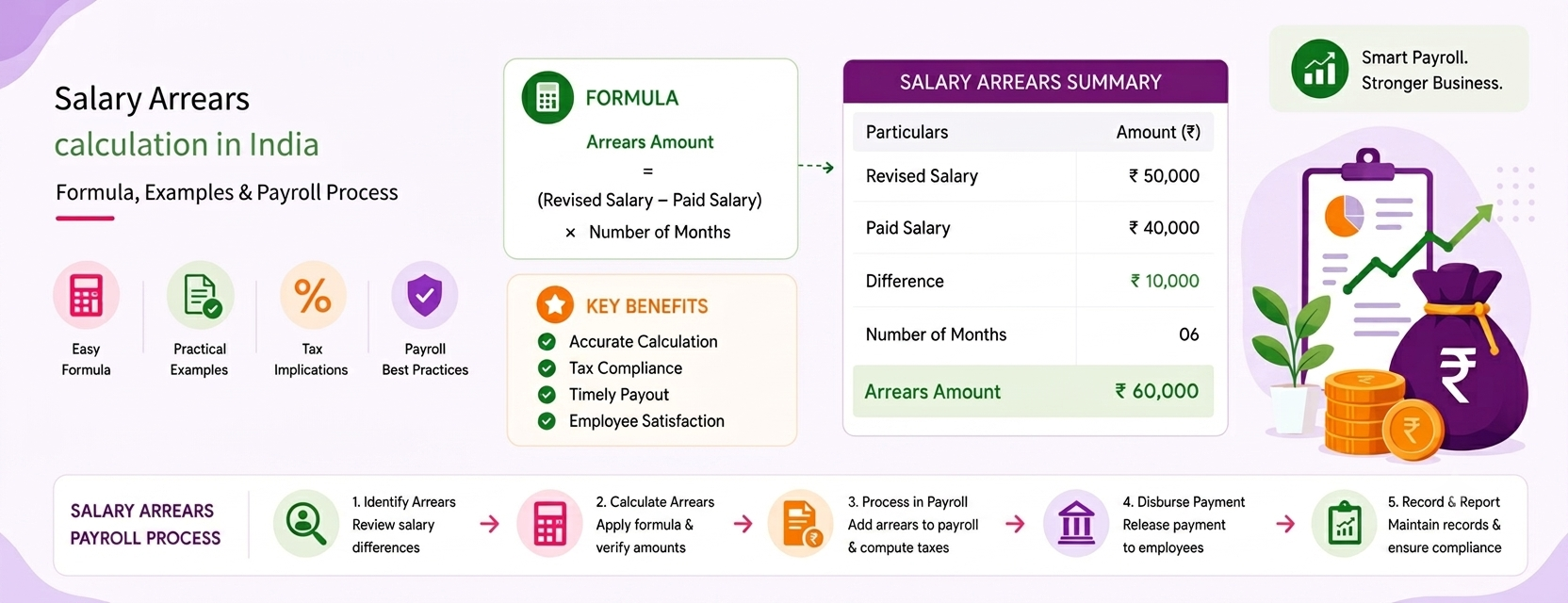
The salary arrears amount is calculated by finding the difference between the revised salary and the salary already paid for the applicable period.
Formula:
Salary Arrears = Revised Salary − Previously Paid Salary
If the revision applies to multiple months, multiply the monthly difference by the number of affected months.
Salary Arrears Calculation Example
Example:
- Previous Monthly Salary: ₹45,000
- Revised Monthly Salary: ₹50,000
- Effective Date: 1 April
- Salary Revision Implemented: July Payroll
Monthly Difference:
₹50,000 − ₹45,000 = ₹5,000
Number of Pending Months:
April, May, June = 3 months
Salary Arrears:
₹5,000 × 3 = ₹15,000
The employee will receive ₹15,000 as salary arrears in the July payroll.
Factors to Consider Before Processing Salary Arrears
Before processing salary arrears, HR and payroll teams should verify:
- Effective date of the salary revision
- Number of months affected
- Attendance and Leave Without Pay (LWP)
- Overtime or shift allowances
- Applicable deductions
- Income tax implications
- Required approvals
Verifying these details helps ensure accurate calculations and minimizes payroll errors.
Tax Treatment of Salary Arrears
Salary arrears are generally taxable as part of the employee’s income in the financial year in which they are received.
Payroll teams should calculate the applicable Tax Deducted at Source (TDS) before processing arrears. Employees may also be eligible for tax relief under applicable provisions of the Income-tax Act, subject to eligibility and prevailing tax regulations.
Common Mistakes to Avoid
Avoid these common payroll errors when processing salary arrears:
- Using an incorrect effective date
- Missing eligible months
- Ignoring attendance or Leave Without Pay (LWP)
- Incorrect tax calculations
- Duplicate arrears payments
- Processing without approval
A structured review process helps reduce these errors and ensures payroll accuracy.
How Sumopayroll Simplifies Salary Arrears Processing
Sumopayroll helps HR and payroll teams manage salary arrears efficiently by enabling them to:
- Record salary revisions
- Apply retrospective salary changes
- Automatically calculate arrears
- Recalculate statutory deductions
- Generate accurate payslips
- Maintain payroll history and reports
By automating salary arrears calculations, Sumopayroll reduces manual effort, minimizes errors, and ensures employees receive accurate payments on time.
Frequently Asked Questions
What are salary arrears?
Salary arrears are payments made for salary that was due in a previous payroll period but was paid later because of salary revisions, corrections, or delayed processing.
Are salary arrears taxable?
Yes. Salary arrears are generally taxable in the financial year in which they are paid, subject to applicable tax laws.
How are salary arrears calculated?
Salary arrears are calculated by finding the difference between the revised salary and the salary already paid, then multiplying that amount by the number of affected months.
Can payroll software calculate salary arrears automatically?
Yes. Modern payroll software like Sumopayroll can automatically calculate salary arrears, apply deductions, generate payslips, and maintain complete payroll records.
Conclusion
Salary arrears are a common part of payroll management, especially when salary revisions or corrections are implemented retrospectively. Calculating arrears accurately helps ensure employees receive the correct amount while maintaining payroll accuracy and compliance.
Using an automated payroll solution like Sumopayroll simplifies salary arrears processing by reducing manual calculations, improving accuracy, and helping HR teams process payroll efficiently.