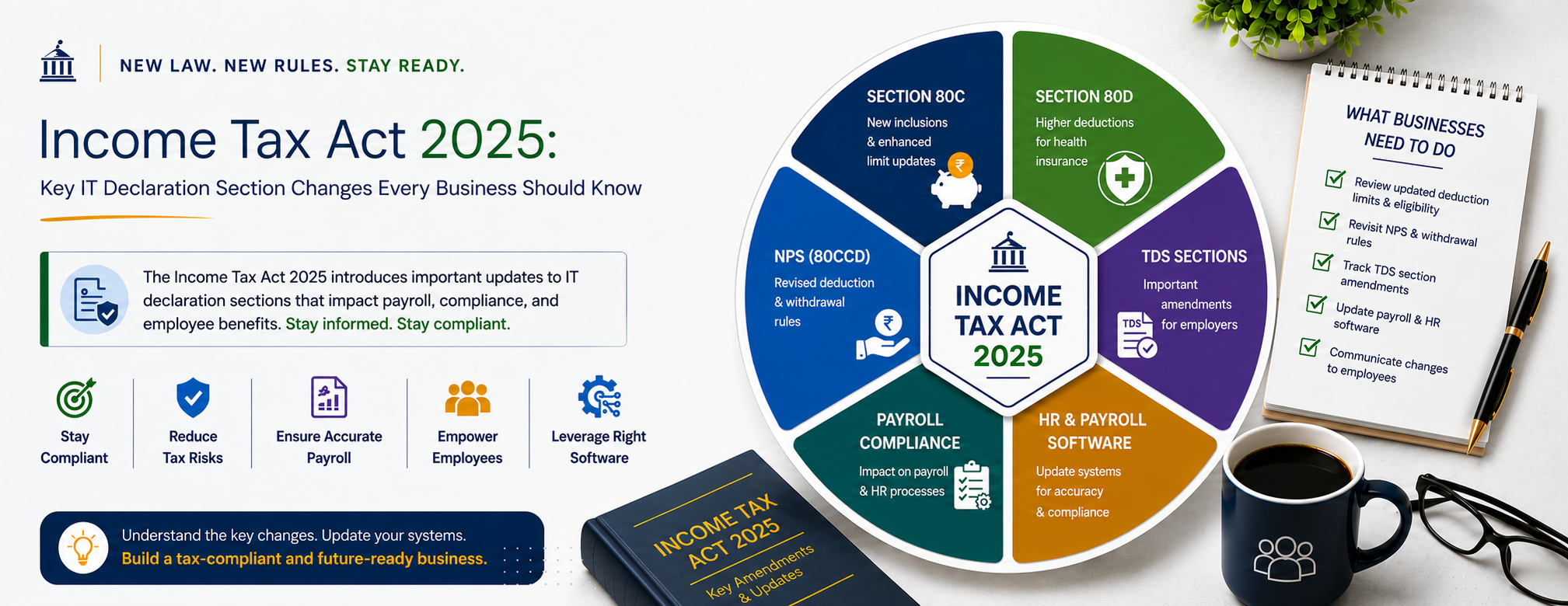
The Income Tax Act 2025 introduces major IT declaration section changes that directly impact payroll processing, employee tax declarations, HR compliance, and payroll software workflows across India. Businesses using HRMS and payroll software must update tax section mappings, IT declaration modules, and TDS calculations to stay compliant with the revised tax framework.
For HR teams, finance departments, payroll professionals, and business owners, understanding these changes is essential to ensure accurate payroll processing and smooth employee tax declaration management.
In this blog, we’ll explore the important Income Tax Act 2025 section changes, their impact on payroll compliance, and how modern payroll software can help businesses manage the transition efficiently.
What is the Income Tax Act 2025?
The Income Tax Act 2025 is introduced to simplify and modernize India’s taxation system by replacing the older Income Tax Act, 1961.
The updated framework focuses on:
- Simplifying tax laws
- Improving tax compliance
- Reducing payroll and taxation complexity
- Streamlining tax administration
- Enhancing clarity for employees and employers
While most deductions and exemptions remain unchanged, several income tax sections have been reorganized and renumbered to improve readability and compliance management.
Why IT Declaration Section Changes Matter for Businesses
Every financial year, employees submit investment declarations and tax-saving proofs through HRMS or payroll software platforms.
With the revised section numbering under the Income Tax Act 2025, organizations need to update:
- IT declaration forms
- Payroll software workflows
- Employee tax declaration processes
- TDS calculation logic
- Investment proof management
- Payroll compliance documentation
Without these updates, businesses may face:
- Incorrect payroll tax calculations
- Employee confusion during IT declarations
- Compliance risks
- Manual payroll processing errors
- Delays in TDS management
For organizations managing large workforces, automated HR payroll software becomes essential for handling these tax updates efficiently.
Major IT Declaration Section Changes Under Income Tax Act 2025
| Existing Section | New Section | Purpose |
| 80C | Section 123 | Tax-saving investments |
| 80CCD | Section 124 | NPS deductions |
| 80D | Section 126 | Health insurance deductions |
| 24(b) | Section 22 | Home loan interest deduction |
| 87A | Section 156 | Tax rebate |
| 115BAC | Section 202 | New tax regime |
| 192 | Section 392 | TDS on salary |
These revised sections are aimed at simplifying payroll compliance and making income tax provisions easier to understand for businesses and employees.
Section 80C is Now Section 123
One of the biggest changes under the Income Tax Act 2025 is the transition of Section 80C to Section 123.
Employees can continue claiming deductions for:
- Employee Provident Fund (EPF)
- Public Provident Fund (PPF)
- ELSS mutual funds
- Life insurance premiums
- Tuition fees
- Home loan principal repayment
- Tax-saving fixed deposits
The deduction limit of ₹1.5 lakh remains unchanged.
Businesses using payroll software in India should update IT declaration forms and employee investment workflows to reflect the revised section mapping.
NPS Deductions Shifted to Section 124
National Pension System (NPS) deductions previously covered under Section 80CCD are now grouped under Section 124.
This includes:
- Employee NPS contributions
- Additional NPS deductions
- Employer NPS contribution benefits
The updated structure helps simplify retirement-related tax deductions under the new tax framework.
Medical Insurance Deduction Moved to Section 126
Health insurance deductions previously claimed under Section 80D are now covered under Section 126.
Employees can continue claiming deductions for:
- Self and family health insurance
- Parents’ medical insurance
- Senior citizen medical expenses
Organizations should ensure these revised references are updated across payroll systems, tax declaration software, and employee IT declaration modules.
Impact of Income Tax Act 2025 on Payroll & HR Teams
The Income Tax Act 2025 payroll changes require organizations to review and modernize payroll compliance processes.
Key areas requiring updates:
- Payroll software configuration
- IT declaration modules
- Employee tax declaration forms
- TDS calculation workflows
- Payroll compliance reports
- HRMS tax documentation
Many organizations are expected to temporarily display both old and new section references for better employee understanding.
Example:
- Section 123 (Earlier 80C)
- Section 126 (Earlier 80D)
This transition approach helps reduce confusion and ensures smoother payroll operations.
How Payroll Software Helps Businesses Stay Compliant
Modern HRMS and payroll software can simplify the transition to the Income Tax Act 2025 by:
- Automating IT declarations
- Updating tax section mappings
- Simplifying investment proof submission
- Managing employee tax declarations digitally
- Ensuring accurate payroll tax calculations
- Reducing manual payroll errors
- Improving payroll compliance efficiency
Cloud-based payroll software solutions help businesses adapt quickly to tax law changes while improving operational productivity and employee experience.
Steps Businesses Should Take Before Transitioning
To ensure smooth implementation of the Income Tax Act 2025, organizations should take proactive steps.
1. Upgrade Payroll & HRMS Systems
Ensure all revised tax sections are updated across payroll workflows.
2. Revise IT Declaration Forms
Update employee tax declaration forms with the new section numbering structure.
3. Train HR & Payroll Teams
Educate payroll administrators and HR teams about the revised tax framework.
4. Communicate Changes to Employees
Help employees understand updated tax sections and declaration workflows.
5. Review Payroll Compliance Processes
Validate TDS calculations, investment declarations, and payroll tax logic.
FAQs on Income Tax Act 2025
What is the new section for 80C in Income Tax Act 2025?
Section 80C has been renamed as Section 123 under the Income Tax Act 2025.
Will tax deductions change under Income Tax Act 2025?
Most tax deductions and benefits remain unchanged. The major update is the restructuring and renumbering of sections.
How does Income Tax Act 2025 affect payroll software?
Payroll software must update IT declaration forms, tax section mappings, TDS calculations, and compliance workflows.
Why should businesses update payroll systems for Income Tax Act 2025?
Updated payroll systems help ensure accurate tax compliance, smooth payroll processing, and efficient employee tax declaration management.
What are the major payroll compliance changes under Income Tax Act 2025?
The major changes include revised tax section mappings, updated TDS references, and modifications to employee IT declaration processes.